
The Dehydrating Book
Influencer MarketingWater For People and Edelman printed a children's book in hydrochromic ink, readable only when wet, gone when dry, to reframe the water crisis as a barrier to learning and re-engage donors during aid funding cuts.
About the campaign
In 2024, international aid for clean water faced historic cuts, donor fatigue was blunting conventional appeals, and Water For People's programmes were at risk just when renewed support mattered most. Edelman spotted two problems in one: US audiences frame the water crisis as a health issue rather than an education issue, and facts alone rarely shift behaviour where physical, emotional experiences do.
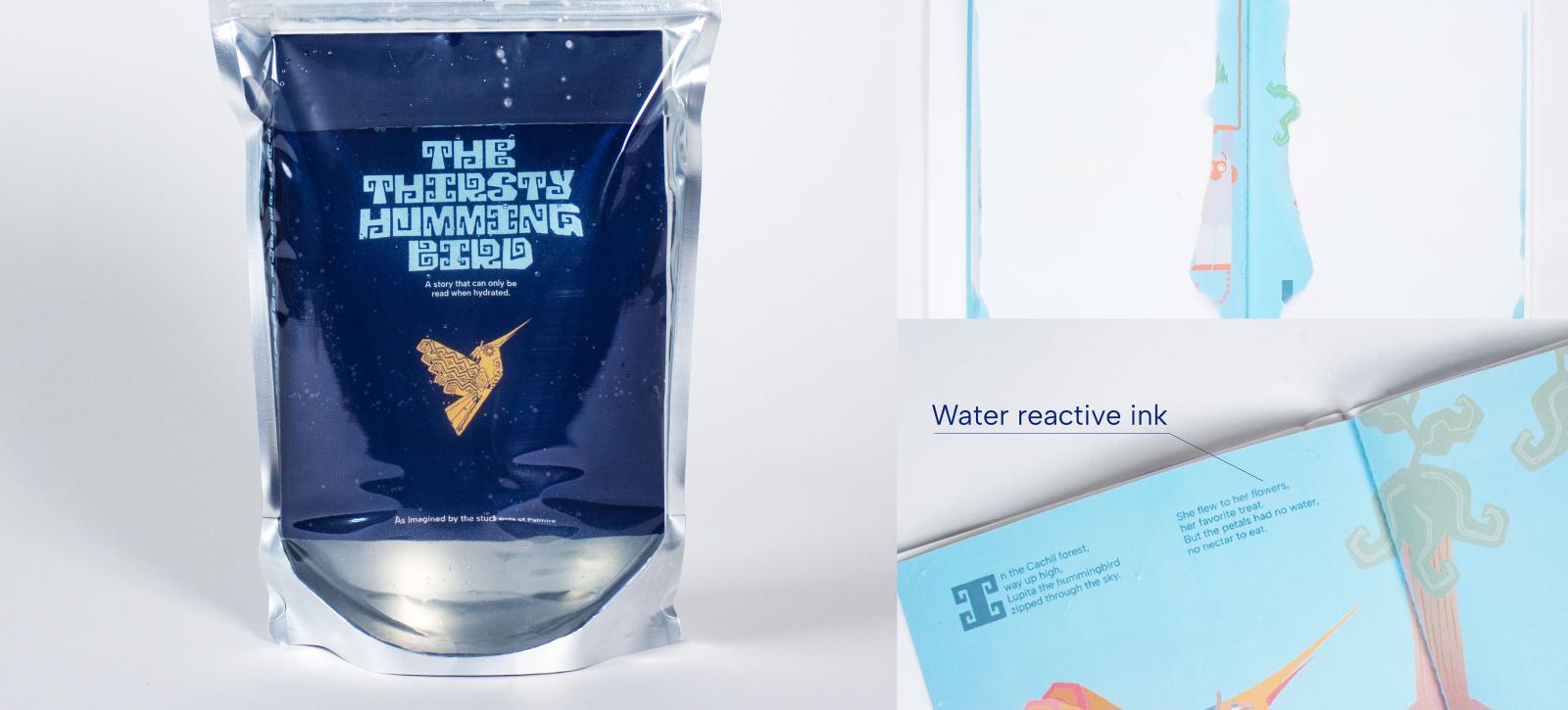
The answer was The Dehydrating Book, a children's book printed in hydrochromic ink that is readable only when wet and fades to blank white as the pages dry, making water the literal interface and its absence the message. The story was co-created with students, families and teachers from Palmira, a village in Peru's Cascas Valley, with custom letterforms built from the Andean Cross. Production partner The Gas Company printed 130 copies on synthetic paper, flood-coated with hydrochromic ink, and packaged them underwater in a 10-gallon aquarium so they shipped in water-filled pouches.
Launched on 20 March 2025 around World Water Day, the books were mailed to key donors and influencers, anchoring a multichannel campaign that earned coverage in Fast Company, Dezeen and beyond. Edelman reports a 294 percent surge in high-intent donation traffic, a 68 percent donation increase over two weeks and 118 percent growth in new donor revenue, and the work won the Fundraising Campaign category at the 10th Shorty Impact Awards.
Case in 60 seconds
In 2024, international aid for clean water faced historic cuts, putting Water For People's programmes at risk. Donor fatigue and conventional appeals were losing impact at the exact moment renewed support was most needed.
Edelman identified that U.S. audiences tend to frame the global water crisis as a health issue rather than an education issue, and that facts alone rarely shift behaviour while physical, emotional experiences do.
Create a children's book printed in hydrochromic ink that is legible only when wet and fades to blank white as the pages dry, so that water becomes the literal interface and its absence becomes the message.
The book — co-created with students, families and teachers from Palmira, a village in Peru's Cascas Valley — was mailed to key donors and influencers around World Water Day on 22 March 2025, anchoring a multichannel campaign that included social storytelling and earned media coverage in outlets including Creative Salon, LBBonline, Dezeen and Fast Company.
Edelman reports a 294% surge in high-intent donation traffic, a 68% increase in donations over two weeks, 118% growth in new donor revenue, and 40,609 people reached through the donor funding generated. The campaign won the Fundraising Campaign category and a Silver Honor in Non-Profit at the 10th Annual Shorty Impact Awards.
Strategy Breakdown
The primary strategy-learning section — interpretation, not a press-release summary.
Creative & Execution System
Assets & channels
- Physical book printed on Super Yupo synthetic paper using a Heidelberg XL 102 UV litho press, flood-coated with hydrochromic ink on a silkscreen press
- 3mm white acrylic cover and spine boards milled to form an angled closure, finished matte
- Water-filled sealed pouch packaging; entire packaging process performed underwater in a 10-gallon aquarium to prevent dehydration in transit
- Direct mail to key donors and influencers
- Multichannel social storytelling
- Earned media: Creative Salon, LBBonline, Dezeen, Fast Company
Partners
- Edelman (lead agency, concept development)
- The Gas Company, Toronto (graphic arts production studio, approached by Edelman NYC)
Participation mechanic
- Recipients must wet the pages to read the story — water is the access mechanism
- Pages return to blank white as they dry, recreating the experience of loss
- Influencer and donor recipients share their interaction, extending the campaign socially
Creator role
- Influencers received the physical book as a gifted mailer and were expected to document and share their experience of wetting and reading the pages
- Students, families and teachers from Palmira, Peru co-created the story, characters, and landmarks drawn from their lived experience
Results & Evidence
| Metric | Value | Result type |
|---|---|---|
| High-intent donation traffic surge | 294% | Traffic / Behavioural |
| Donations increase (two-week window) | 68% | Conversion / Revenue |
| New donor revenue growth | 118% | Conversion / Revenue |
| Annual new subscriber growth | 40%+ | Audience Growth |
| People reached through donor funding | 40,609 | Social Impact |
| Schools reached through donor funding | 29 | Social Impact |
Awards & Recognition
| Award show | Year | Category | Result |
|---|---|---|---|
| Shorty Impact Awards | 2025 | Fundraising Campaign | Winner |
| Shorty Impact Awards | 2025 | Non-Profit | Silver Honor |
Why Edelman's strategy worked
- 1
**Medium as message**: The book required water to be read, mapping directly onto the campaign's argument that children need water to learn. Edelman's own assessment and the Shorty Impact Awards citation both credit this alignment between production technique and strategic insight as central to the work's effectiveness. When the mechanic demonstrates the point, explanation becomes unnecessary.
- 2
**Physical experience over stated facts**: Edelman's stated behavioural insight was that physical and emotional experiences shift donor behaviour more reliably than data. A tactile object that forces interaction with the issue — rather than presenting information about it — gave recipients something qualitatively different from a conventional appeal at a time of acknowledged donor fatigue.
- 3
**Reframing the issue**: Positioning water access as an education barrier rather than a health issue, as Edelman identifies, widened the emotional relevance of the campaign. A book about a child's ability to learn — rather than an appeal about illness — connected the crisis to values (literacy, opportunity, childhood) that a broader donor base already holds.
- 4
**Community co-creation added specificity and credibility**: The story was developed with students, families and teachers from Palmira in Peru's Cascas Valley, and the custom typography was grounded in Andean Cross symbolism. This gave the campaign a specificity that generic cause appeals lack and reflected the lived experience of the communities it described.
- 5
**Precision targeting over mass reach**: With only a small, hand-crafted print run produced, the campaign concentrated its most powerful asset on the highest-value audience — existing donors and influencers — rather than pursuing broad distribution. The reported conversion results suggest this trade-off was effective, though it limits how broadly the gains can be attributed to the physical object versus the surrounding earned media.
- 6
**Earned media multiplied a limited physical run**: Coverage in Creative Salon, LBBonline, Dezeen and Fast Company extended the campaign well beyond its physical footprint. The distinctiveness of the production process — packaging performed underwater in a 10-gallon aquarium — was itself newsworthy and gave journalists a concrete, visual story to tell.
Results
10M+
Views
5M+
Impressions
20K+
New followers

Results
51.7M+
Total views
2.9M+
Interactions
17.7%
Engagement rate