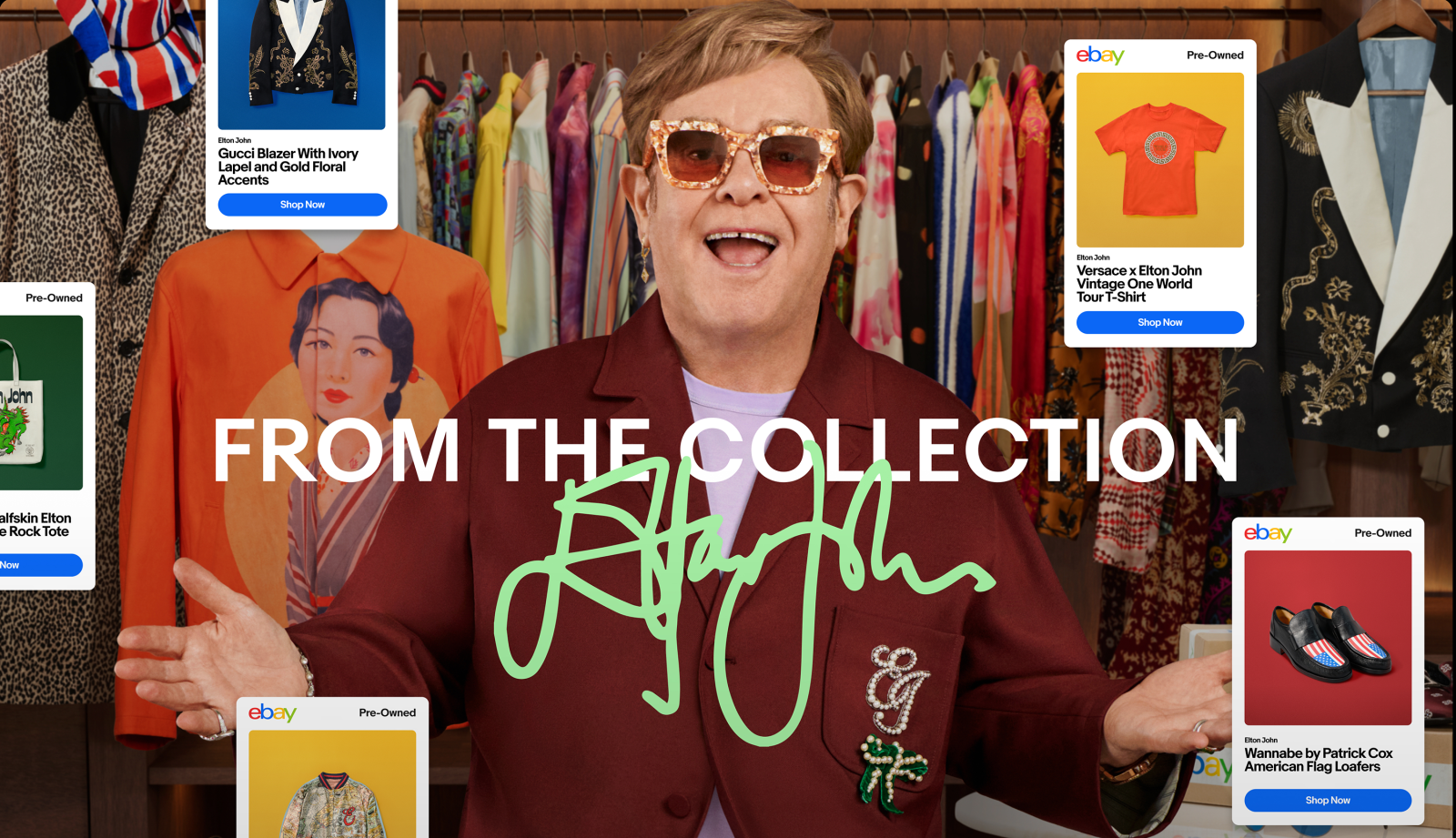

From the Collection
Influencer MarketingEdelman repositioned eBay as a premium destination for rare goods by turning cultural icons' personal collections into exclusive curated storefronts, driving 18B earned media impressions.
About the campaign
eBay had lost cultural relevance and, by its own account, nearly one million sellers in a single year, as newer, design-led platforms drew top-tier sellers away and left the marketplace associated with quirky bargains rather than rare, quality inventory. Edelman diagnosed the problem as perception rather than product: change who people associate with selling on eBay and you change how sellers and buyers view the platform.
From the Collection did exactly that, converting the personal collections of cultural icons into exclusive curated eBay storefronts, launching with Heron Preston and expanding across fashion, motorsport and music with partners including Elton John, Ken Block and Jenna Lyons. Each drop offered rare, personal items available only on eBay, with 100 percent of proceeds donated to charity, a structure that removed any financial motive from the partners' participation and reinforced credibility.
Amplification combined livestream auctions, influencer collaborations, social campaigns, editorial storytelling and pop-ups, layering earned media over owned eBay channels and each partner's own audience. The brief was explicitly value over volume, attracting more valuable sellers rather than simply more of them.
eBay and Edelman report 18 billion earned media impressions, more than 575,000 direct visits to eBay, over $1 million in auction sales donated to charity, and a 24 percent-plus increase in average GMV per seller, all self-reported figures.
Case in 60 seconds
eBay had lost cultural relevance and, by its own account, nearly one million sellers in a single year. Newer, design-led platforms were drawing top-tier sellers away, leaving eBay associated with quirky bargains rather than quality or rare inventory.
The platform's problem was perception, not product. If eBay could change who people associated with selling on the site, it could shift how both sellers and buyers viewed the marketplace as a destination for rare and valuable goods — as framed by Edelman.
Edelman built a program around cultural icons — including Elton John, Ken Block, and Jenna Lyons — converting their personal collections into curated eBay storefronts, making the platform the exclusive home for items that carried genuine cultural weight.
Each drop offered rare, personal items sold only on eBay, with 100 percent of proceeds donated to charity. Amplification spanned livestream auctions, influencer collaborations, social campaigns, editorial storytelling, and pop-ups, combining earned media at scale with owned eBay channels and each partner's own audience. The program launched with Heron Preston and expanded across fashion, motorsport, and music.
eBay and Edelman report 18 billion earned media impressions, more than 575,000 direct visits to eBay, over $1M in auction sales donated to charity, and a 24%+ increase in average GMV per seller. All figures are self-reported and have not been independently audited.
Strategy Breakdown
The primary strategy-learning section — interpretation, not a press-release summary.
Creative & Execution System
Assets & channels
- Curated eBay storefronts (owned platform)
- Livestream auctions
- Social media campaigns (organic and paid, platforms not specified in sources)
- Editorial and PR storytelling
- Pop-up activations
- Partner/influencer owned channels
Partners
- Edelman (lead agency, per Edelman case page and Wonderful Machine)
- Wonderful Machine (production, per Wonderful Machine)
- Heron Preston (launch partner, per Edelman)
- Elton John (cultural partner, per Edelman)
- Ken Block (cultural partner, per Edelman)
- Jenna Lyons (cultural partner, per Edelman)
Participation mechanic
- Exclusive item listings available only on eBay per drop
- 100% of proceeds from each auction donated to charity
- Time-limited drops generating repeatable earned media moments
- Each drop tailored to the partner's voice and existing audience
Creator role
- Talent as product supplier (selling personal collection items)
- Talent as credibility signal for the eBay platform
- Talent as audience bridge to new seller and buyer segments
Results & Evidence
| Metric | Value | Result type |
|---|---|---|
| Earned media impressions | 18 billion | Reach |
| Direct visits to eBay | 575,000+ | Traffic |
| Auction sales donated to charity | $1M+ | Commercial / social impact |
| Average GMV increase per seller | 24%+ | Commercial |
Why Edelman's strategy worked
- 1
When a legacy platform's core problem is perception rather than product, changing who is visibly associated with the brand can move seller and buyer behaviour more directly than feature improvements or broad advertising — as the program's value-over-volume framing illustrates.
- 2
The charity mechanic served a strategic purpose beyond PR optics: by removing a financial motive from the partners' participation, it strengthened the credibility signal that the repositioning required, making each drop harder to read as a simple paid endorsement — per Edelman's account.
- 3
Exclusivity as platform lock-in — making each drop available only on eBay — gave the marketplace a structural role in each cultural moment rather than positioning it as one of several distribution options for a partner's items.
- 4
Tying earned media to time-limited drops with named partners created repeatable news moments across different cultural verticals (fashion, motorsport, music), allowing the program to accumulate credibility incrementally rather than relying on a single launch event.
- 5
Beginning with a credible but not overwhelming cultural figure (Heron Preston) before expanding to larger names (Elton John, Ken Block, Jenna Lyons) suggests a sequencing logic that allowed the platform and the program mechanics to build before carrying higher-profile risk.

Results
51.7M+
Total views
2.9M+
Interactions
17.7%
Engagement rate

Results
10M+
Views
5M+
Impressions
20K+
New followers