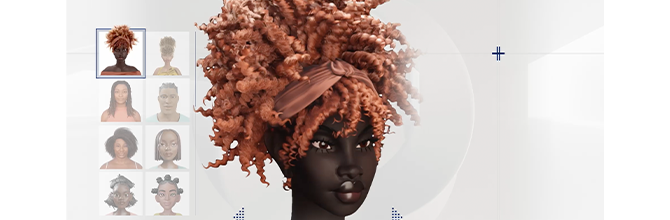

Code My Crown
Influencer MarketingDove and Edelman created a free 200-page open-source guide teaching game developers how to code Black hair textures, turning a representation gap into a solvable technical problem.
About the campaign
Black gamers were systematically underrepresented in video games, especially in the accurate depiction of textured hair, but research by Dove and Edelman across 1,002 gamers and 160 developers in the US and UK reframed the problem: 74 percent of developers said they would help improve representation of textured Black hair if they could learn how to code it. The barrier was capability, not unwillingness, and that insight turned a representation argument into a solvable technical problem.
Rather than run a message-led awareness campaign in a category where a beauty brand has no commercial role, Dove built a tool: Code My Crown, described as the first free guide training game developers to code Black hairstyles and textures. Produced with the Open Source Afro Hair Library and a team of Black 3D artists, animators and programmers, the 200-page downloadable guide combined step-by-step coding instruction, 360-degree photo-mapping, cultural insights and 15 original hair sculpts designed as the foundation for hundreds of virtual styles, released open-source through a dedicated website with a campaign film and social content.
The work extended Dove's two-decade Real Beauty platform and its CROWN Act advocacy into gaming, and won the Business to Business category plus a Gold Honor in Diversity, Equity and Inclusion at the 9th Shorty Impact Awards; guide adoption figures are not disclosed.
Case in 60 seconds
Black gamers were systematically underrepresented in video games, particularly in the accurate depiction of textured hair, but the barrier was not just attitudinal — developers lacked the knowledge and tools to code it correctly.
Research across gamers and developers in the US and UK found that developers surveyed said they would help promote better representation of textured Black hair if they could learn how to code it, reframing the issue from unwillingness to capability gap.
Rather than run a message-led awareness campaign, Dove and Edelman produced what they describe as the first free guide training game developers to code Black hairstyles and textures, giving a beauty brand a credible, practical role in a category it does not compete in.
Edelman collaborated with the Open Source Afro Hair Library and a team of Black 3D artists, animators and programmers to build a 200-page downloadable guide featuring step-by-step coding instruction, 360-degree photo-mapping and cultural insights, supported by a dedicated website, campaign film and social content.
The campaign won the Business to Business category and earned a Gold Honor in Diversity, Equity & Inclusion at the 9th Annual Shorty Impact Awards; downstream adoption metrics for the guide are not disclosed in available sources.
Strategy Breakdown
The primary strategy-learning section — interpretation, not a press-release summary.
Creative & Execution System
Assets & channels
- 200-page downloadable open-source developer guide (primary asset)
- Dedicated campaign website
- Campaign film
- Social media content
- Gaming-led activity (details not specified in sources)
Partners
- Edelman (lead agency)
- Open Source Afro Hair Library (co-development partner)
- Black 3D artists, animators and programmers (credited as collaborators in guide production)
Participation mechanic
- Free guide download open to any game developer
- Open-source licensing enabling reuse and redistribution by the wider development community
Creator role
- Black 3D artists, animators and programmers contributed to creating original hair sculpts and coding instruction content
- No influencer or user-generated content mechanic described in sources
Results & Evidence
| Metric | Value | Result type |
|---|---|---|
| Black gamers feeling underrepresented in video games | 85% | context |
| Female gamers (research finding) | 48% | context |
| Gamers who are people of color (research finding) | 29% | context |
| Gen Z who play games (research finding) | 87% | context |
Awards & Recognition
| Award show | Year | Category | Result |
|---|---|---|---|
| Shorty Impact Awards | 9th Annual (year not specified in sources) | Business to Business | Winner |
| Shorty Impact Awards | 9th Annual (year not specified in sources) | Diversity, Equity & Inclusion | Gold Honor |
| Shorty Impact Awards | 9th Annual (year not specified in sources) | Business to Business — Audience Honor | Audience Honor |
Why Edelman's strategy worked
- 1
Converting a representation argument into a practical tool gave a brand outside the gaming category a credible, durable reason to act. Edelman reframed the problem from an awareness issue to a solvable technical one, which is harder to dismiss as brand virtue-signalling.
- 2
Developers said they would help if taught to code textured hair, anchoring the campaign in that finding meant the guide addressed a stated need rather than an assumed one, giving the business-to-business audience a reason to engage.
- 3
Open-sourcing the guide extended its useful life beyond a campaign window and invited reuse by the wider development community, giving the asset value independent of Dove's media spend.
- 4
Dove's prior credibility with the Black community through CROWN Act advocacy gave the brand standing to enter the gaming conversation rather than appearing as an opportunistic interloper.
- 5
Pairing quantitative research scale with in-depth qualitative conversations gave the research both breadth and lived-experience context, making the problem harder to dismiss as anecdotal.
- 6
Targeting developers (business-to-business) rather than only consumers created a multiplier: equipping people who shape games means any adoption has ongoing impact across future titles rather than a one-time consumer-facing moment.
Results
51.7M+
Total views
2.9M+
Interactions
17.7%
Engagement rate

Results
10M+
Views
5M+
Impressions
20K+
New followers