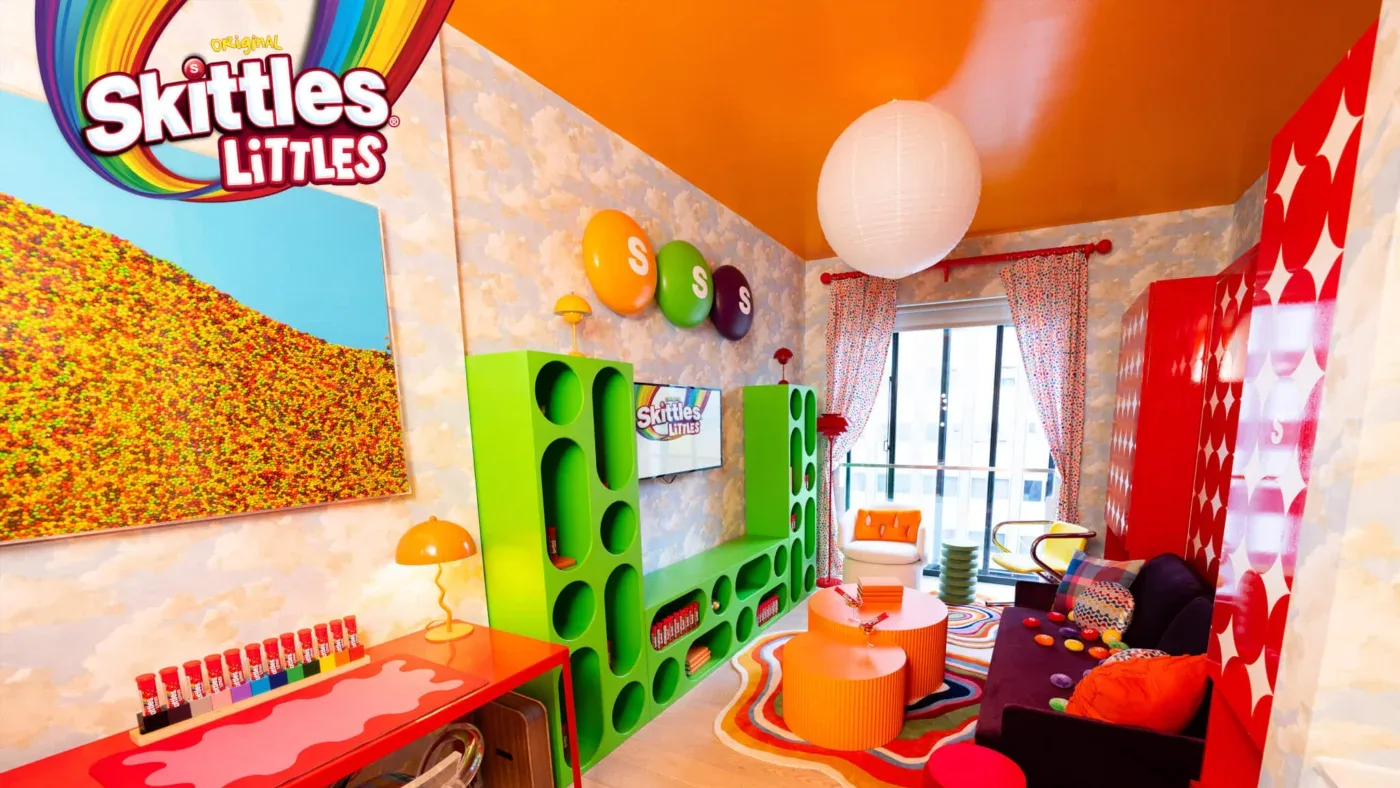

SKITTLES Littles Living
Weber Shandwick launched SKITTLES Littles by renting out a redesigned New York micro-apartment for a year, drawing over 17K applications in under two weeks.
Case in 60 seconds
SKITTLES released a new product whose news was its size rather than its taste, so the launch had to build brand equity and engage the existing community while reaching new Gen Z fans in a crowded confectionery category.
The campaign appears to turn on Gen Z reading small space living as a design problem rather than a compromise, because tiny apartments and maximalist decorating were already running as trends across the feeds the brand wanted to enter.
Translate the product's defining attribute, its reduced size, into a place a fan could actually live, so that the launch story is told through a small home made maximal rather than through product messaging.
Weber Shandwick redesigned a 353 square foot New York City micro-apartment around SKITTLES Littles with maximalist designer Dani Klari, listed it for one fan to live in rent free for a year with SKITTLES paying all costs, and had Caleb Simpson tour the space on social before it went to market.
Weber Shandwick reports the launch reached Gen Z social feeds and media coverage in new verticals, fuelled a viral news moment that earned a spot on The Late Show with Stephen Colbert, and drove over 17K applications in under two weeks without anyone seeing the space in person.
Strategy Breakdown
The primary strategy-learning section — interpretation, not a press-release summary.
Creative & Execution System
Assets & channels
- apartment tour
- social content
Partners
- Weber Shandwick (lead_agency)
Participation mechanic
- Fans applied to live in the redesigned micro-apartment for one year rent free, with SKITTLES covering all of the costs, and the page reports over 17K applications in under two weeks.
Creator role
- Caleb Simpson — creator
- Dani Klari — creator
Results & Evidence
| Metric | Value | Result type |
|---|---|---|
| applications | driving over 17K applications in under two weeks without anyone seeing the space in-person | performance |
Why Weber Shandwick's strategy worked
- 1
A product change that is only a change of scale can carry a launch when the scale itself is staged at human size, because the audience judges the idea by what it can enter rather than by what the packaging claims.
- 2
Handing an existing trend to the creator most associated with it, in this case a maximalist designer and a home tour creator, appears to buy entry to a conversation that a brand arriving on its own would have to argue its way into.
- 3
A prize that solves a live cost problem, here a year of New York rent, reads as the driver of the application volume, because signing up answers something the audience already wanted rather than something the brand wanted for it.
- 4
The reported applications arrived before anybody saw the apartment in person, which suggests creator-led video tours can substitute for physical access when the offer is concrete enough to act on.

Results
10M+
Views
5M+
Impressions
20K+
New followers

Results
51.7M+
Total views
2.9M+
Interactions
17.7%
Engagement rate