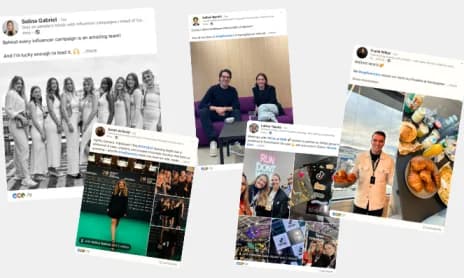

Kingfluencers Employee Ambassador Campaign
Influencer MarketingKingfluencers ran an employee ambassador programme on its own staff and measured it against its corporate LinkedIn account over the same twelve months.
About the campaign
This is the one case study on Kingfluencers' site about Kingfluencers. The agency ran an Employee Ambassador Program on its own staff and published the results, which makes it both a marketing asset and, unusually, a controlled comparison, because the company measured its ambassadors against its own corporate LinkedIn account over the same twelve months.
Five employees posted in their own names about ordinary agency work, who the teams are, what they do and why it matters, publishing 76 posts across the year. The corporate account continued in parallel, publishing 125 posts in the same window. The framing throughout is that the two are complementary rather than competing, with the corporate channel carrying consistent brand presence and company news while individuals carry the personal material.
The comparison is the substance here. Five people posting 39% less often produced roughly 34% more impressions, 156,000 against 116,000, and more engagements, 3,440 against 2,492. That is a meaningful result for an agency arguing that distributed personal accounts beat centralised corporate ones, and it is worth more than the raw numbers because both sides were measured on the same platform, in the same period, about the same company.
Kingfluencers reports 156,000 impressions, 3,440 engagements, 2,053 average impressions per post and a 2.2% engagement rate. Two caveats attach. This is the agency assessing its own programme with no external verification, and the comparison does not account for the ambassadors' combined follower count against the corporate account's, which would determine how much of the gap reflects the format rather than the reach available to each. All figures are self-reported.
Case in 60 seconds
Kingfluencers wanted to test whether employees speaking in their own names build more visibility and trust for an agency than its corporate channel does.
Personal accounts and the corporate account do different jobs, one carrying company news and consistent presence, the other carrying the material only a person can post.
Give five employees a voice through an Employee Ambassador Program covering ordinary agency work, who the teams are, what they do and why it matters.
The five ambassadors published 76 posts on LinkedIn over twelve months while the corporate account continued in parallel with 125 posts in the same window.
Kingfluencers reports 156,000 impressions and 3,440 engagements from the ambassadors against 116,000 impressions and 2,492 engagements from the corporate account, at 2,053 average impressions per post and a 2.2% engagement rate.
Strategy Breakdown
Creative & Execution System
Assets & channels
- LinkedIn posts from five named employees
- The corporate Kingfluencers LinkedIn account running in parallel
Partners
- Kingfluencers
Participation mechanic
- Employees given a voice to share unfiltered insights into day-to-day work
- Personal storytelling about teams, work and why it matters
Creator role
- 5 employee ambassadors, including Frank Ritter, Rafael Buchli and Sarah Schmid
Results & Evidence
| Metric | Value |
|---|---|
| Ambassador Impressions | 156k |
| Ambassador Engagements | 3,440 |
| Average Impressions per Post | 2'053 |
| Engagement Rate | 2.2% |
| Corporate Account Impressions | 116,000 |
| Corporate Account Engagements | 2,492 |
| Ambassador Posts Published | 76 |
| Ambassadors Activated | 5 |
Why Kingfluencers' strategy worked
- 1
Running the ambassadors alongside the corporate account rather than instead of it produced a comparison on the same platform, in the same period, about the same company, which is rarer than the claim it supports.
- 2
Five people posting 39% less often produced roughly 34% more impressions and more engagements, which is the case's substance.
- 3
Personal posts about ordinary work, who the teams are and what they do, gave the ambassadors material the corporate account could not credibly publish.
- 4
Framing the two channels as complementary avoided the false choice between a corporate presence and personal accounts.

Results
10M+
Views
5M+
Impressions
20K+
New followers

Results
51.7M+
Total views
2.9M+
Interactions
17.7%
Engagement rate