
Michael CeraVe
Influencer MarketingCeraVe staged a fake conspiracy that Michael Cera created the brand, then debunked it in a Super Bowl ad to reassert its dermatologist-developed positioning.
About the campaign
CeraVe sat in a crowded skincare market saturated with celebrity endorsements, its dermatologist-developed heritage under pressure from competitor claims and its following limited to a niche TikTok audience. Ogilvy's read of the category was that skincare marketing leans on celebrity endorsement while audiences enjoy pulling apart what is real and what is staged, so a deliberately suspicious celebrity story would invite participation rather than skepticism fatigue. Because Michael Cera shares part of his name with the brand, the claim that he created CeraVe was absurd enough to be funny and plausible enough to debate.
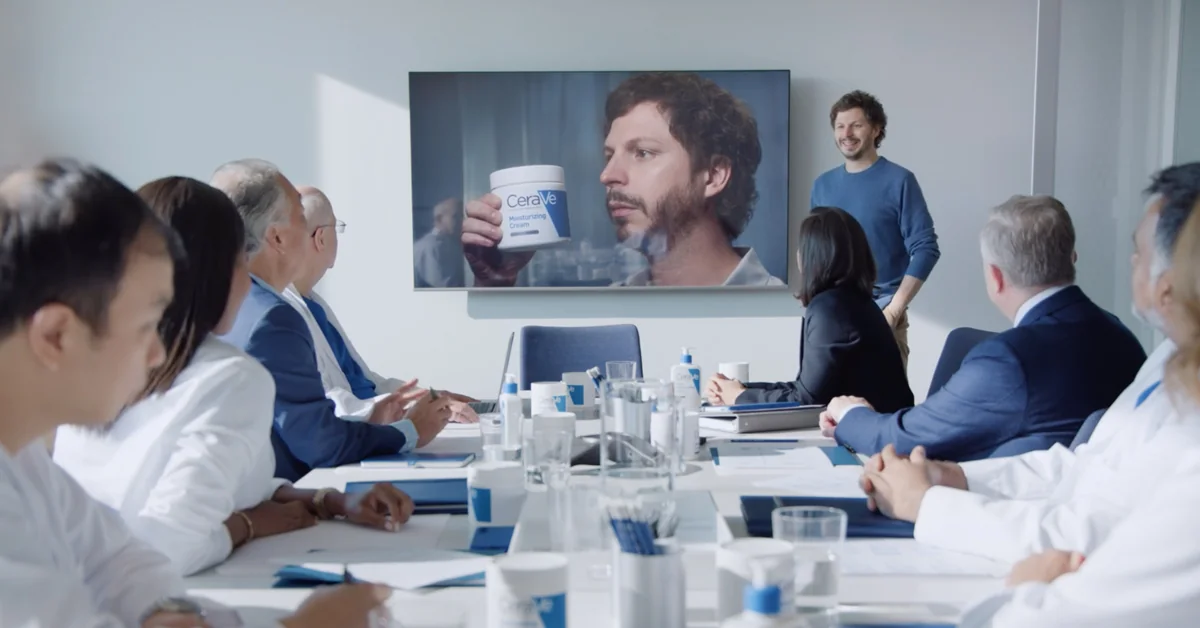
The campaign, run by WPP Onefluence and led by Ogilvy PR North America, spread the lie that Cera developed CeraVe, then debunked it in a Super Bowl commercial with the truth that the brand is developed with dermatologists. Creator HayleeBaylee released a seemingly candid video of Cera signing CeraVe bottles, paparazzi-style photos circulated, Cera released his own fake commercial, and the Super Bowl spot delivered the debunk through a boardroom of CeraVe dermatologists.
It worked because a name coincidence made speculation itself the distribution mechanism, and because the reveal was the brand claim, so attention resolved onto CeraVe's positioning rather than dissipating with the joke. The work ran across social media, influencers, earned media and the Super Bowl broadcast. No achieved performance figures appear in the reviewed sources; the campaign won five categories at the 17th Annual Shorty Awards, and Ogilvy's page lists a Cannes Lions Grand Prix and a Super Clio.
Case in 60 seconds
CeraVe sat in a crowded skincare market saturated with celebrity endorsements, its dermatologist-developed heritage under pressure from competitor claims, and its following limited to a niche TikTok audience.
Michael Cera shares part of his name with the brand and is known for his youthful looks, so the claim that he created CeraVe was absurd enough to be funny and plausible enough to debate.
Spread the lie that Michael Cera developed CeraVe, then debunk it in a Super Bowl commercial with the truth: CeraVe is developed with dermatologists.
Creator @HayleeBaylee released a seemingly candid video of Cera signing CeraVe bottles, paparazzi-style photos circulated, Cera released his own fake commercial, and the Super Bowl spot delivered the debunk.
WARC reports the campaign delivered 32B earned impressions and a 25% increase in sales, while WPP's case study credits it with more than 2,000 media articles and the #1 share of voice among Super Bowl advertisers. It also won five categories at the Shorty Awards, and Ogilvy's page lists a Cannes Lions Grand Prix and a Super Clio.
Strategy Breakdown
Creative & Execution System
Assets & channels
- Seemingly candid creator video of Michael Cera signing CeraVe bottles
- Paparazzi-style photos of Cera with CeraVe products
- Cera's own fake 'Michael CeraVe' commercial
- Super Bowl-aired TV commercial (the debunk)
- Social media across earned, paid and owned channels
Partners
- WPP Onefluence
- Ogilvy PR North America
- Michael Cera
- @HayleeBaylee
Participation mechanic
- The public was invited into a prank-like experience, speculating on and sharing the conspiracy before the reveal
Creator role
- Creators sparked speculation with content that looked discovered rather than advertised, in place of traditional endorsements
Results & Evidence
| Metric | Value |
|---|---|
| Media Articles | 2,000+ |
| Sales Increase | 25% |
| Audience Growth | 5% |
| Earned Impressions | 32B |
| Super Bowl Share of Voice | #1 |
Awards & Recognition
| Award show | Year | Category | Result |
|---|---|---|---|
| Shorty Awards | Not stated | Beauty | Winner |
| Shorty Awards | Not stated | Multi-Platform Partnership | Winner |
| Shorty Awards | Not stated | Use of Viral Content | Winner |
| Shorty Awards | Not stated | Multi-Platform Presence | Winner |
| Shorty Awards | Not stated | Storytelling | Winner |
| Shorty Awards | Not stated | Integrated Campaign | Finalist |
| Shorty Awards | Not stated | Multi-Platform Campaign | Silver Honor |
| Shorty Awards | Not stated | Beauty | Audience Honor |
| Cannes Lions | Not stated | Not stated | Grand Prix |
| Super Clio | Not stated | Not stated | Super Clio |
Why Ogilvy's strategy worked
- 1
A name coincidence gave the hoax a premise absurd enough to be funny and plausible enough to debate, making speculation itself the distribution mechanism.
- 2
Seeding through seemingly candid creator content and paparazzi-style photos kept the conspiracy feeling discovered rather than advertised.
- 3
Because the reveal was the brand claim, developed with dermatologists, attention resolved onto CeraVe's positioning instead of dissipating with the joke.
- 4
Holding the debunk for a mass-reach moment, the Super Bowl, gave the social-led build-up a clear payoff point.
Results
10M+
Views
5M+
Impressions
20K+
New followers
Results
51.7M+
Total views
2.9M+
Interactions
17.7%
Engagement rate