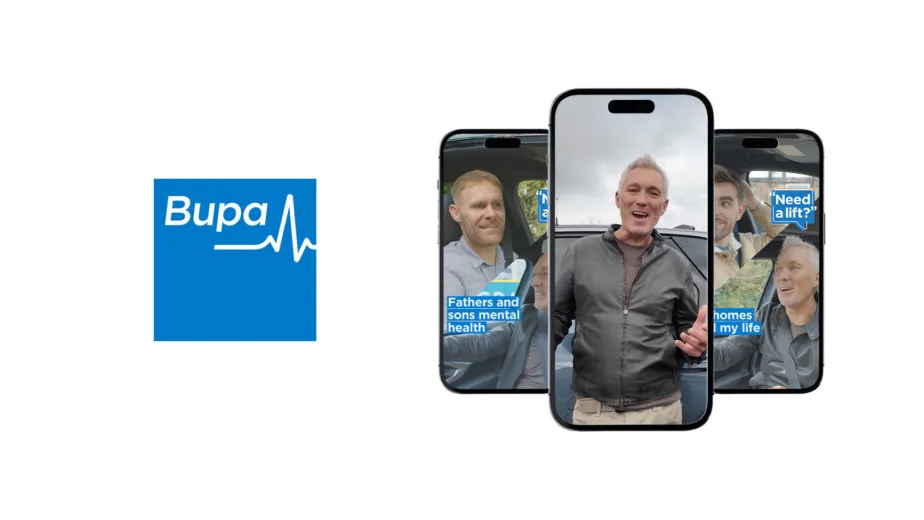

BUPA - Need a Lift
Coolr built a road trip content series for Bupa that turned side-by-side car conversations into men's health talk, reaching 5M+ people across YouTube, TikTok and Instagram.
Case in 60 seconds
Bupa set out against the lingering taboo around men talking openly about wellbeing, and the brief went past awareness because the harder task was creating genuine permission for men to open up at all.
The campaign appears to turn on a behavioural finding Coolr cites, that men talk more comfortably side-by-side rather than face-to-face, because relaxed everyday settings such as car journeys remove the confrontation that a sit-down conversation carries.
Coolr converted that behavioural truth into a road trip format, with Martin Kemp driving so each journey became a safe informal space where honest conversation could happen as a by-product of going somewhere.
Martin Kemp drove a diverse mix of macro and micro creators, including Mark Ormrod MBE, Graeme Sutherland and Mesha Moinirad, through conversations on health, resilience and mental wellbeing, with every film shaped alongside Bupa clinicians and cut into long-form YouTube episodes plus short-form versions for TikTok and Instagram, anchored at launch by Martin's teaser film during Men's Mental Health Awareness Month.
Coolr reports the campaign reached 5M+ people and delivered 98.9% positive sentiment, with delivery across YouTube, TikTok and Instagram, and describes the effect as normalising the conversations rather than only starting them.
Strategy Breakdown
Creative & Execution System
Assets & channels
- TikTok
- YouTube
- long-form YouTube episodes
- short-form cut-downs
- teaser film
Partners
- Coolr
Creator role
- Graeme Sutherland — creator
- Mark Ormrod MBE — creator
- Martin Kemp — creator
- Mesha Moinirad — creator
- a diverse mix of macro and micro creators
Results & Evidence
| Metric | Value |
|---|---|
| People Reached | 5M+ people reached |
| Positive Sentiment | 98.9% positive sentiment |
Why Coolr's strategy worked
- 1
A cultural insight about how a group already behaves can create permission for vulnerable conversation, because the format borrows an existing comfort rather than asking the audience to adopt a new one.
- 2
Side-by-side formats unlock honesty where face-to-face fails, which suggests the physical staging of an interview carries as much weight as the questions asked in it.
- 3
Credibility on sensitive health material comes from pairing lived experience with expert guidance, so clinician involvement functions as a production input rather than a compliance check applied at the end.
- 4
Casting macro and micro creators together spreads a single format across audience sizes, because the anchor talent supplies the initial pull while smaller creators sustain reach after launch.
Results
10M+
Views
5M+
Impressions
20K+
New followers
Results
51.7M+
Total views
2.9M+
Interactions
17.7%
Engagement rate