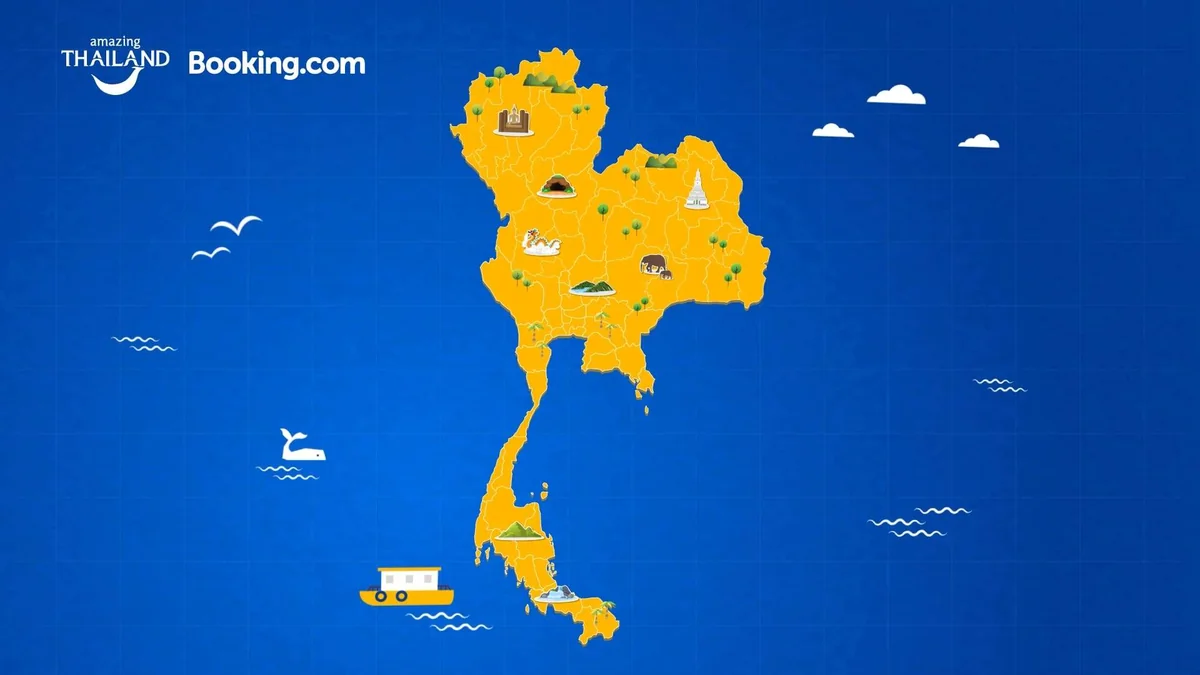

Thai Foodie Map 2.0 with Booking.com and Tourism Authority of Thailand
Influencer MarketingYear two of #ExploreThaiTaste: a guidebook of 40 hand-picked restaurants across eight provinces, built to pull tourists beyond Bangkok and Chiang Mai.
About the campaign
Tourism drives about 7.25% of Thailand's GDP, yet more than 60% of tourists visit only the primary cities, leaving secondary destinations to miss out on the economic benefit. The tension Vero worked from was that travellers say they want to immerse themselves in local culture, 86% of Thai tourists in Booking.com's survey, but most never leave Bangkok and Chiang Mai where that immersion is shallowest. Booking.com research also found 78% of Thai travellers are more interested than before in where a destination's must-taste dishes come from, pointing to food as the lever that could move where people actually go.
For year two of the #ExploreThaiTaste programme, Vero, Booking.com and the Tourism Authority of Thailand built Thai Foodie Map 2.0, a guidebook of 40 hand-picked local restaurants across eight provinces, Sukhothai, Uttaradit, Nakhon Phanom, Surin, Nakhon Nayok, Suphan Buri, Chumphon and Satun, each paired with nearby attractions so a single meal becomes a plannable itinerary. It launched via a Bangkok press announcement on 4 October 2024, with the public-private structure letting a commercial brand ride a national tourism agenda credibly.
The premise held because a map of named restaurants turns a policy goal, dispersing tourism, into something a traveller can act on the same day, and the strongest signal was renewal: an expanded second year after Vero reports year one earned strong stakeholder feedback and a PRCA Thailand Purpose Award. No performance figures for year two have been published, Vero's agency role is documented only on its own site, and the client's press materials confirm the campaign but credit no agency.
Case in 60 seconds
Tourism drives about 7.25% of Thailand's GDP, but most tourists visit only the primary cities, so secondary cities miss out on the economic benefits.
Booking.com research found Thai travelers are more interested than before in the origins of a destination's must-taste dishes, and foodie travelers favour traditional craftsmanship over food trends.
Give travelers a concrete reason to go somewhere new: Thai Foodie Map 2.0, a guidebook of culinary journeys through Thailand's Hidden Gem Cities under the #ExploreThaiTaste banner.
40 hand-picked local restaurants across eight provinces, Sukhothai, Uttaradit, Nakhon Phanom, Surin, Nakhon Nayok, Suphan Buri, Chumphon, and Satun, each paired with nearby attractions, launched via a Bangkok press announcement in October 2024.
No performance figures for year two have been published. The clearest signal is renewal: the partnership returned for an expanded second year after Vero reports year one earned strong stakeholder feedback, media engagement, and a PRCA Thailand Purpose Award.
Strategy Breakdown
The primary strategy-learning section — interpretation, not a press-release summary.
Creative & Execution System
Assets & channels
- Thai Foodie Map 2.0 guidebook with restaurant and attraction pairings
- Launch press release via Booking.com newsroom
- Earned coverage in Thai national media
Partners
- Booking.com
- Tourism Authority of Thailand (TAT)
- Vero (self-reported)
Participation mechanic
- Travelers use the map to plan food-led routes through eight Hidden Gem provinces, with local attractions bundled into each stop
Creator role
- Vero lists influencer engagement among the campaign's services, but no creators, platforms, or content formats are documented in the available sources
Results & Evidence
| Metric | Value | Result type |
|---|---|---|
| Coverage pieces | 205 | media |
| Major outlet coverage | 88 | media |
| Press reach | 254B | reach |
| Engagements | 547K | engagement |
| Impressions | 8.8M | reach |
Why Vero's strategy worked
- 1
A guidebook of named restaurants converts a policy goal, tourism dispersal, into something a traveler can act on the same day.
- 2
Anchoring the creative in the client's own research into food-origin interest gives the premise a defensible base.
- 3
Pairing each restaurant with nearby attractions turns a meal into an itinerary, which is what secondary cities actually need.
- 4
Renewal is evidence: an expanded second year means the programme cleared the client's internal bar even without public metrics.
- 5
A public-private structure, platform plus tourism authority, lets a commercial brand ride a national policy agenda credibly.

Results
51.7M+
Total views
2.9M+
Interactions
17.7%
Engagement rate

Results
10M+
Views
5M+
Impressions
20K+
New followers