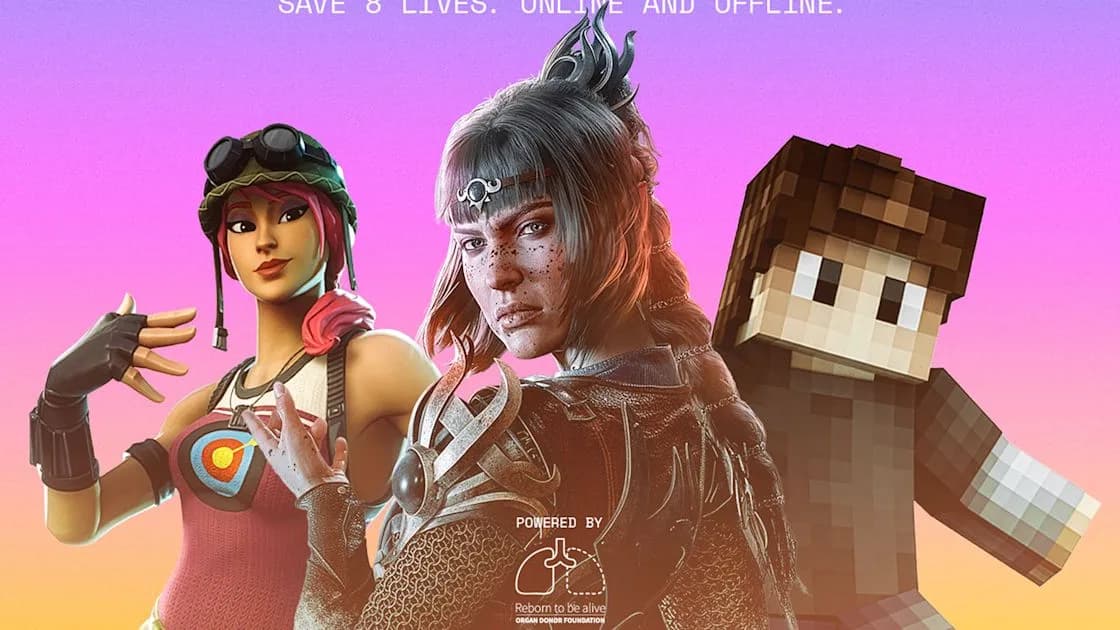

Virtual Donors
Influencer MarketingAKQA built game mods and a registration site for Re-born to be Alive that turned losing a virtual life into organ donor sign-ups, reporting +68% real life donors registered.
Case in 60 seconds
In Belgium many organ donations are missed because people never record their wishes, which leaves families deciding in emotionally difficult moments where they tend to decline when the donor's wish is unclear.
The campaign appears to turn on the fact that losing a life is routine and consequence free for gamers, because a mechanic the audience already performs daily can carry a meaning that public health communication struggles to make relevant to them.
The organizing thesis sets a lost virtual life against the eight lives one real donor can save, so registering as an organ donor becomes the act that grants teammates eight extra lives in game.
AKQA partnered with developers to code custom mods for Minecraft, Fortnite and Baldur's Gate 3 that trigger eight extra lives for teammates when a registered donor dies in game, and built VirtualDonors.org to connect that experience to official government registration. Popular gaming streamers and content creators showcased the mods live, while PR materials carried the launch into national and international press.
AKQA reports 10M PR reach across gaming and mainstream media, +68% real life donors registered and 12,000 potential lives saved, describing the result as a surge in official registrations rather than attention alone.
Strategy Breakdown
Creative & Execution System
Assets & channels
- Other
Partners
- AKQA
Participation mechanic
- Players register as official organ donors and in return unlock a mod that grants eight extra lives to teammates upon their in-game death, so the act of taking part is the registration itself.
Results & Evidence
| Metric | Value |
|---|---|
| PR Reach | 10M PR reach |
| Real Life Donor Registrations Increase | +68% Real life donors registered |
| Potential Lives Saved | 12,000 Potential lives saved |
Why AKQA's strategy worked
- 1
A behaviour a category cannot make interesting can borrow relevance from a mechanic the audience already performs, because the reward lands in the moment of dying rather than in a separate public health appeal.
- 2
Routing an in-game action to an official government register depends on legal and partnership work across non-profit, gaming and public sectors, which the page treats as a named workstream rather than a technical afterthought.
- 3
Streamers demonstrating a mod live give a public health message peer credibility that placement rarely buys, because the demonstration happens inside the audience's own habit of watching other people play.

Results
6.46M
Impressions
-60%
Cpm vs contracted
-70%
Cpa drop since launch


Results
+248
Content pieces
5.4M
Potential reach
3.91%
Engagement ratio