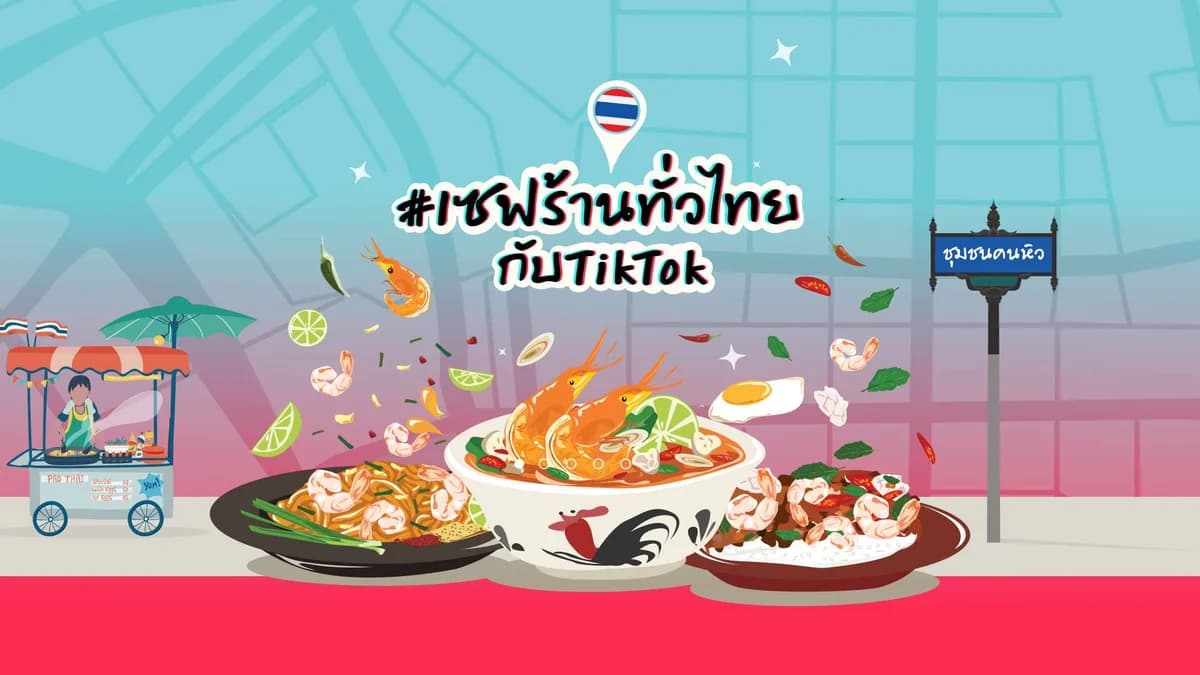

TikTok's Save Small Businesses in Thailand
PR & CommunicationsVero turned TikTok into a participative movement to support Thai restaurants closing under COVID-19 restrictions, reporting 4M+ impressions.
About the campaign
COVID-19 restrictions were closing Thai restaurants at scale, with at least 50,000 closures in Bangkok alone and around 500,000 workers out of jobs, and no government strategy was outlined to help. Delivery-app advertising was too costly for the small restaurants that needed exposure most. Vero's research into Thais aged 18 to 35 pointed to a way through: this audience was eager to help others, each had a favourite local store or restaurant, and many held a strong personal bond with those businesses.
Working with TikTok, Vero built Save Small Businesses as a participative movement rather than a paid push, positioning the platform as a force for the greater good that could give local restaurants more visibility. The campaign activated both active and lapsed TikTok users, and made geography and geolocalization the competitive element so that support felt local and personal while still scaling nationwide. Food was TikTok's focus area for the second half of the year, and the mechanic channelled existing user goodwill toward the restaurants people already loved.
Anchoring the idea in an existing motivation gave users a personal reason to take part instead of relying on reach, and casting TikTok as a civic actor during a crisis gave the platform a credible role. The work ran entirely in-platform on TikTok, where Vero reports more than 4.7 million impressions, 100K sticker views and 1.5 billion views on hashtag videos. These figures come from Vero's own case-study page, with no independent verification, and business outcomes for the restaurants themselves were not disclosed in available sources.
Case in 60 seconds
COVID-19 restrictions were closing Thai restaurants, with at least 50,000 closures in Bangkok alone and 500,000 workers out of jobs, and no government strategy outlined to help. Delivery-app advertising was too costly for small restaurants.
Vero's research found 18 to 35 year old Thais were eager to help others, each had a favourite local store or restaurant, and often had a strong personal relationship with these businesses.
Position TikTok as a platform for the greater good, helping small and local restaurants gain exposure through a participative movement that users themselves drive.
The campaign activated both current and lapsed TikTok users, using geography and geolocalization as the competitive element to make participation feel local and personal, built to scale nationwide.
Vero reports more than 4 million impressions. No independent verification or further outcome metrics are available in the sources.
Strategy Breakdown
Creative & Execution System
Assets & channels
- TikTok in-platform campaign
Partners
- Vero
- TikTok (client and platform)
Participation mechanic
- Users activated to support their favourite local restaurants together
- Geography and geolocalization used as the competitive element
Creator role
- Not documented in sources
Results & Evidence
| Metric | Value |
|---|---|
| Impressions | 4.7M |
| Views on Hashtag-Tagged Videos | 1.5B |
| Sticker Views | 100K |
Why Vero's strategy worked
- 1
Anchoring the mechanic in an existing motivation, people's bond with a favourite local restaurant, gave users a personal reason to take part rather than relying on paid reach.
- 2
Making geography and geolocalization the competitive element turned a nationwide brief into something that felt local and personal.
- 3
Positioning the platform as a civic actor during a crisis, when no government support strategy existed, gave TikTok a credible and relevant role.
- 4
Targeting lapsed users alongside active ones treated a purpose campaign as a platform re-engagement opportunity.
.webp&w=1200&q=75)
Results
9M
Engagements
43M
Impressions
68K
Link clicks


Results
160%
Ctr increase
2,000%
Engagements increase
200K
Linkedin engagements