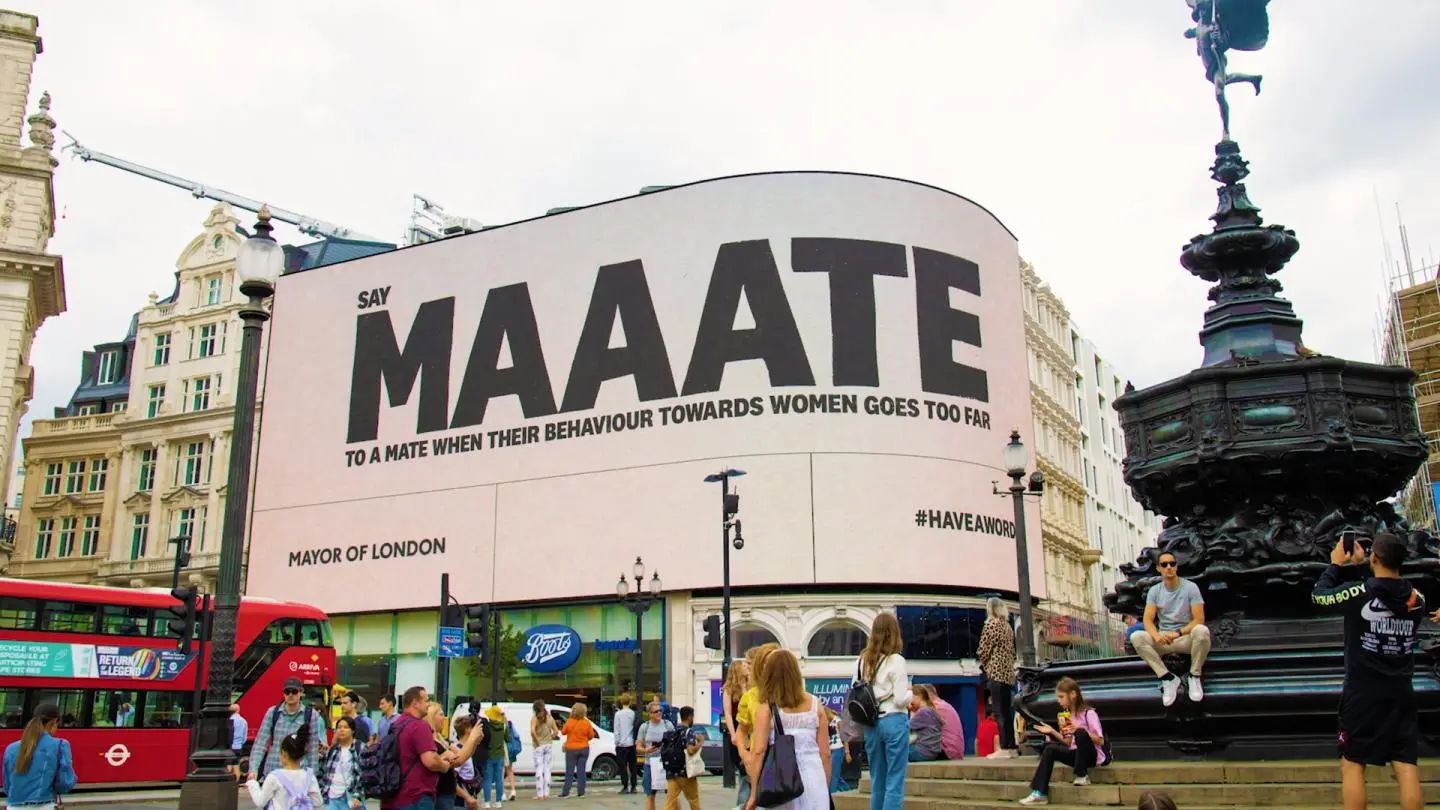

Say Maaate to a Mate
Influencer MarketingOgilvy UK gave men one word to call out misogyny among friends, turning 18-24 year-olds from least to most likely to intervene and earning over 1 billion impressions.
About the campaign
Research commissioned by the Mayor of London found that two in three men want to step in when they hear misogynistic language but do not know what to say, and one in four London men aged 19 to 34 regretted not calling out a friend. Ogilvy UK's behaviour science team spent time observing men in bars, barbershops and gyms and found they want to challenge friends with respect and levity, not shame, since shaming is an ineffective strategy and intervention works best from a place of friendship.
The answer was a single familiar word, Maaate, a repeatable verbal tool that fits how friends actually speak and can interrupt a misogynistic conversation without humiliating anyone. Launched on 21 July 2023, the word was seeded into culture through a bespoke stand-up routine by comedian Romesh Ranganathan, social media activist Max Selwood, a LADbible creator network collaboration that reached 12 million people and became the platform's top performing post ever, fly-posting-style out-of-home across London, and an interactive film with up to 270 possible endings directed by Koby Adom and built with Vimeo, in which viewers use a skip-ad-style button to interject and change the conversation.
The campaign reports over 1 billion impressions, with 85 percent of men aged 18 to 24 saying they would now try to stop misogynistic behaviour among friends, and it won the ARF David Ogilvy Grand Award.
Case in 60 seconds
A Mayor of London-commissioned study found that two in three men want to step in when they hear misogynistic language but do not know what to say, and one in four London men aged 19-34 regretted not calling out a friend for being misogynistic.
Ogilvy UK's behaviour science team spent time observing men in bars, barbershops and gyms and found that men do not want to shame or ostracise friends, they want to call them out with respect and levity, and that research showed shaming is an ineffective strategy while intervening from a place of friendship respect is most effective.
Give men a single familiar word, 'Maaate', that fits how friends actually speak and that can interrupt a misogynistic conversation without humiliating anyone.
The word was seeded into culture through a bespoke stand-up routine by comedian Romesh Ranganathan, social media activist Max Selwood, a LADbible creator network collaboration, fly-posting-style out-of-home across London, and an interactive film with up to 270 possible endings directed by Koby Adom and developed in partnership with Vimeo.
85% of 18-24 year-old men said they would now try to stop misogynistic behaviour among friends, the campaign earned over 1 billion impressions and won the ARF David Ogilvy Grand Award alongside D&AD and One Show recognition.
Strategy Breakdown
Creative & Execution System
Assets & channels
- Interactive short film with up to 270 possible endings, developed in partnership with Vimeo and directed by Koby Adom
- Bespoke stand-up comedy routine by Romesh Ranganathan performed across the country
- Out-of-home posters in fly-posting style across London, placing 'Maaate' in shapes including a steamroller, anvil and gavel, with headlines drawn from surveys and discussion groups with women and hand-cut from lino
- LADbible creator network collaboration, becoming the platform's top performing post ever
- Paid social media (Instagram, TikTok, YouTube, Facebook)
- Earned media coverage on BBC Radio 1, BBC news and national TV
Partners
- Vimeo (interactive film technology partner)
- LADbible (creator network partner)
- Romesh Ranganathan (comedian talent)
- Max Selwood (social media activist)
- Koby Adom (film director)
Participation mechanic
- Viewers use a 'skip ad'-style button within the interactive film to interject and change the course of the conversation, selecting from branching paths that produce up to 270 possible variants
- The word 'Maaate' was designed as a repeatable verbal intervention men could use in real social situations, practised first in the film environment
Creator role
- Romesh Ranganathan performed a bespoke stand-up routine seeding the word into comedy culture across the country
- Max Selwood acted as a social media activist amplifying the campaign
- LADbible's creator network distributed campaign content to 12 million people
Results & Evidence
| Metric | Value |
|---|---|
| Earned Reach | Over 1 billion |
| LADbible Partnership Reach | 12 million people |
Awards & Recognition
| Award show | Year | Category | Result |
|---|---|---|---|
| ARF David Ogilvy Awards | 2024 | Grand Winner (overall) | Grand |
| ARF David Ogilvy Awards | 2024 | Government, Public Service and Non-Profit | Gold |
| ARF David Ogilvy Awards | 2024 | Social Responsibility | Gold |
| D&AD | 2024 | Not specified in available sources | Graphite Pencil |
| D&AD | 2024 | Not specified in available sources | Wood Pencil |
| The One Show | 2024 | Direct Marketing | Merit |
| Cannes Lions (Creative Strategy Lions) | 2024 | Creative Strategy | Shortlist |
Why Ogilvy's strategy worked
- 1
Translating a known intention gap into a single repeatable action reduced the barrier to behaviour change. Research showed most men wanted to intervene but lacked the words, so supplying one familiar word that fit how friends speak removed the main stated obstacle.
- 2
Matching the creative register to the behavioural insight was central. Ethnographic research confirmed men want to call friends out with respect and levity rather than shame, so using comedy and colloquial language rather than a shaming frame aligned the message with the mechanism most likely to work.
- 3
Using trusted peers and creator networks rather than traditional government advertising channels put the intervention into the social contexts where misogynistic language actually occurs, which behavioural science indicates amplifies message effectiveness.
- 4
The interactive film format moved the work from awareness to skills rehearsal, letting men practise the intervention before encountering the real situation, shifting the campaign's function from description to preparation.
- 5
Seeding a single word across comedy, creator networks, out-of-home and interactive video gave the idea multiple simultaneous entry points into culture, generating earned media at a scale that amplified the paid and organic distribution.

Results
10M+
Views
5M+
Impressions
20K+
New followers
Results
51.7M+
Total views
2.9M+
Interactions
17.7%
Engagement rate